|
|
|

 |
Nybelwyck Hall
Currently on view
A recent gift to the Hudson River Museum, it was created by dollhouse enthusiast Mark O’Banks over the course of a decade. Some of the architectural elements of the 26-room dollhouse were suggested by nineteenth-century houses in the Hudson Valley as well as sites around Washington, D.C.
The façade of the central portion is loosely based on the Hudson River estate, Staatsburg, the Ogden Mills House. The orange and green color scheme on the high Victorian addition is based on Wilderstein, the family home of Franklin Delano Roosevelt’s personal secretary. The concept of the lantern comes from George Washington’s home Mount Vernon. The roof line in the French style was drawn from buildings on Connecticut Avenue in Washington, D.C. O’Banks furnished the house with found objects, rugs that he designed and were executed by his mother, and one of a kind, custom-made pieces. Nybelwyck Hall is filled with allusions to O’Banks’ friends, family, and special moments woven into the story of the dollhouse’s fictional Van Nybelwyck family.
|
|
|
|
|

©1995 Frederick Charles
The Hudson River Museum |
Front Facade
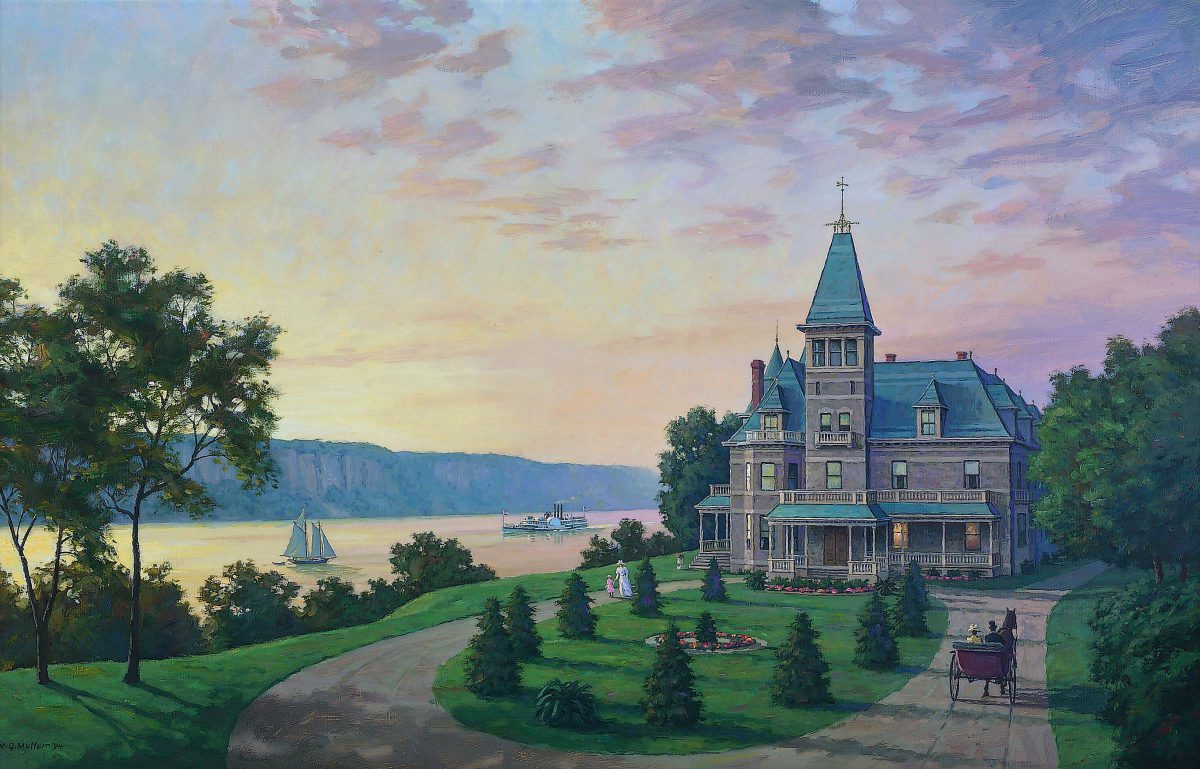
Begun in 1876 and completed in 1877 and overlooking the Hudson River and Palisades, six period rooms of the Mansion have been restored to reflect the lifestyle of its turn-of-the-century residents, the John Bond Trevor family. |
|

©1995 Frederick Charles
The Hudson River Museum |
Grand Staircase in Great Hall
The Dining Room, Sitting Room, Library and Great Hall have magnificently
stenciled ceilings, fine woodwork, furnishings and decorative objects,
paintings, and sculptures. The Great Hall also boasts a beautiful, colorfully tiled floor. |
|

©1999 Peter Daly
The Hudson River Museum |
Sitting Room
The interior design follows the Eastlake style, which incorporates abstracted designs inspired by nature, such as the carved and inlaid sunflower details of the woodwork. Glenview is considered one of the finest examples of an American Eastlake interior open to the public. Delicately incised birds eye maple cabinetry is a notable feature of the Sitting Room. |
|

©1999 Peter Daly
The Hudson River Museum |
Parlor
The Parlor was designed as a whole ensemble: wallpaper; ceiling stencils;textiles and furnishings created a rich layering of pattern, color and texture. Highlights of this room include: Meissen china figure groups and an Italian marble sculpture of Faust and Marguerite.
|
|