Planetarium
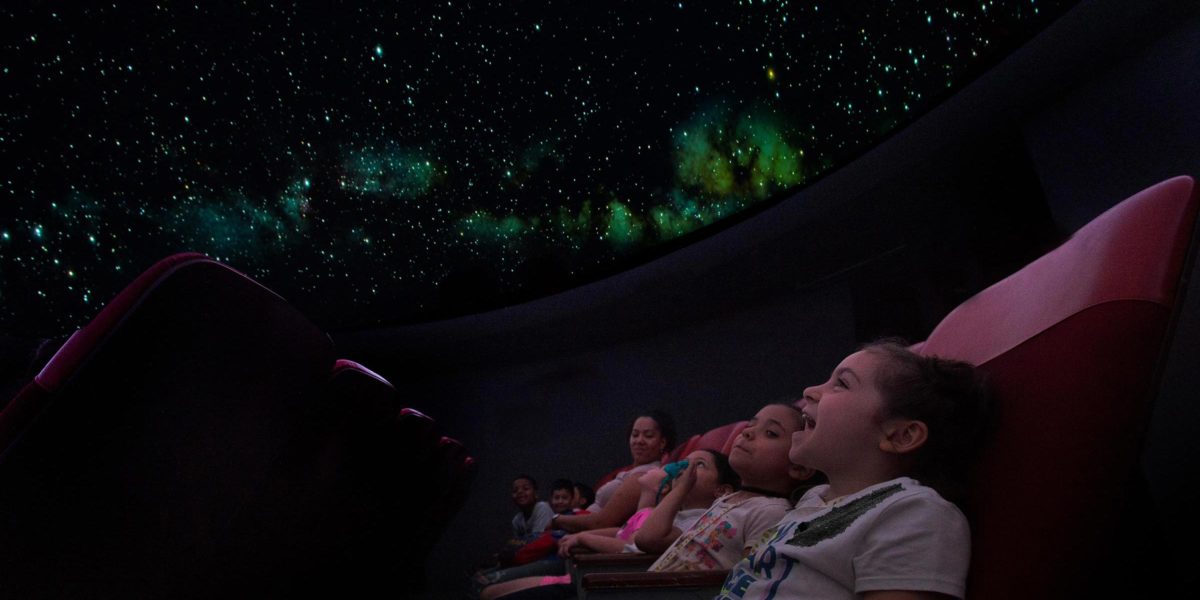
Photo: Yuliya Levit
Planetarium shows are offered every Saturday and Sunday at 11:30am, 12:30pm, 2pm, and 3:30pm, with each time slot geared towards a different age group. 11:30am, 12:30pm, and 3:30pm shows are recommended for young children; 2pm shows, during which visitors explore what the sky will look like later that night, are live, interactive, and open to all ages.
From the mysteries of the moon and the search for life beyond Earth, to the stories that shape our stars, our Planetarium has shows for every level and interest. Check individual show descriptions below for more information. Please note that planetarium shows begin promptly as scheduled, and there is no admittance after they start.
In addition to our weekend screenings, planetarium shows are also offered on select holidays and during school breaks, known as School’s Out, Stars Are In (SOSI). Check our calendar for updates.
The Planetarium is equipped with Radio Frequency Assisted Listening Systems (ALSs). Please ask a member of the Planetarium or visitor services staff for more information.
School & Group Visits
Interested in booking a planetarium show for your school, camp, Scout, or adult group? Learn more here.
Planetarium Birthday Parties & Rentals
Celebrate your special event in the HRM Planetarium! From your child’s next birthday party, to a unique anniversary or milestone celebration, let us take you and your guests on an exclusive, personal tour through the cosmos! Learn more here.

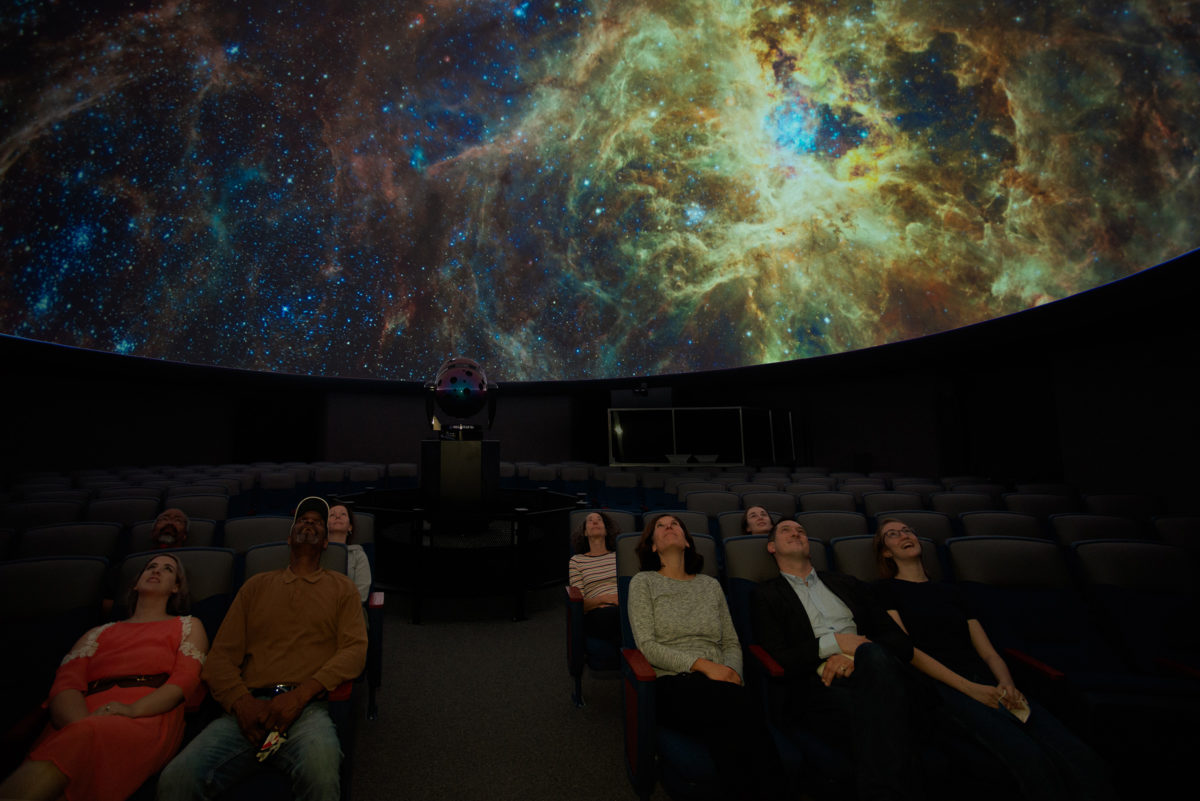
Photo: Yuliya Levit.
All Shows
Asteroid: Mission Extreme (NEW!)

Take a journey 65 million years in the making to discover how asteroids represent both danger and opportunity here on Earth. The danger lies in the possibility of a cataclysmic collision. The opportunity is that asteroids could serve as stepping stones to other worlds, helping us reach the farthest frontiers of the Solar System—and perhaps beyond. Explore the perils and possibilities of these fascinating remnants of our cosmic past. Narrated by award-winning actress Sigourney Weaver.
Produced by SkySkan International and the National Geographic Society.
Recommended for ages 8+; 25 minute show, plus Q&A. Advance ticket purchase is encouraged.
Image: Courtesy of SkySkan / National Geographic Society
Birth of Planet Earth

Join us for Birth of Planet Earth, which tells the twisted tale of our planet’s origins. Scientists now believe that our galaxy is filled with solar systems, including up to one billion planets roughly the size of our own. This program employs advanced, data-driven visualizations to explore some of the greatest questions in science today: How did Earth become a living planet in the wake of our solar system’s violent birth? What does its history tell us about our chances of finding other worlds that are truly Earth-like?
Recommended for ages 8+; 24-minute show plus Q&A. Advance reservations are encouraged.
*Please note the following changes to the planetarium show schedule:
- Planetarium shows will not be offered on Saturday, April 18.
Photo: Spitz Creative Media
Earth and Sky Science

Students explore sky motions and the relationships between objects, while surrounded by an accurate and richly detailed universe simulator.
Earth, Moon, and Sun

Join Coyote, a humorous character drawn from Native American oral traditions, as he explores the relationship between the Earth, Moon, and Sun. Through his amusing misconceptions about our planet and its celestial neighbors, viewers are prompted to think critically about how these three bodies interact as a system. Native American stories are woven throughout the show to highlight the distinction between myth and science.
Recommended for ages 5–10; 26-minute show plus Q&A. Advance ticket purchase is encouraged.
Four Tales of the Sky

Four cultures, four locations on Earth, four takes on stories in the stars. A mixture of live presentations and beautiful short films that tell stories of constellations, astronomical instruments, and scientific knowledge from various cultures around the world. Produced by One Sky Project, each story is in its own artistic style, featuring the work of international artists.
Recommended for ages 8+; 35-minute show plus Q&A. Advance ticket purchase is encouraged.
Photo: One Sky Project/SG360/TMT/‘Imiloa/CalAcademy/NSF’s NOIRLab
Four Tales of the Sky
Four cultures, four locations on Earth, four takes on stories in the stars. A mixture of live presentations and beautiful short films that tell stories of constellations, astronomical instruments, and scientific knowledge from various cultures around the world. Produced by One Sky Project, each story is in its own artistic style, featuring the work of international artists.
Recommended for ages 8+; 35-minute show plus Q&A. Advance ticket purchase is encouraged.
Photo: One Sky Project/SG360/TMT/‘Imiloa/CalAcademy/NSF’s NOIRLab
The Great Solar System Adventure

Join showman extraordinaire “The Great Schiaparelli” as he takes you on a death-defying space-time adventure via his wondrous Observatorium. From the sun-scorched surface of Mercury to the icy expanses of Pluto and beyond, prepare to be subjected to the myriad dangers and wonders of our Solar System. Be warned! The Observatorium isn’t just for show—it will transport you right to the heart of some of the deadliest locations in our corner of the cosmos. It’s going to take some fancy flying to get everyone back in one piece!
Recommended for ages 6+; 25-minute show. Advance reservations are encouraged.
Hazelnuts: In Search of the Perfect Planet

Join us for this new planetarium show featuring Nino and Lilli, two curious (and hungry) squirrels, on an out-of-this-world adventure! They dream of leaving Earth in search of the most delicious super-hazelnuts, but wise old Leon the owl uses his telescope to reveal the true wonders of the planets. A fun and educational journey for all ages!
Recommended for ages 5–10; 25-minute show plus Q&A. Advance reservations are encouraged.
Legends of the Night Sky: Perseus and Andromeda

The stars tell the story of beautiful Andromeda, who is punished by the gods for her mother’s bragging, sacrificed to a sea monster, and then rescued by Perseus.
Recommended for ages 8+; 25-minute show plus Q&A. Advance ticket purchase is encouraged.
Little Skywatchers: A Cosmic Adventure

Join us for a gentle, musical, and interactive journey through the wonders of the night sky, perfect for young explorers just before naptime! Little ones will discover the Sun, Moon, stars, planets, and constellations while singing along to classic favorites and learning a few fun, astronomical tunes. Don’t forget your spacesuit and most importantly—your imagination!
Recommended for ages 3–6; 30-minute live show. Advance ticket purchase is encouraged.
Photo: Steven Paneccasio.
Magic Tree House: Space Mission

Please note, planetarium shows will not be offered on Saturday, August 29.
Travel with Jack and Annie, stars of the Magic Tree House® best-selling children’s book series, as they search for answers to a mysterious riddle they discover in a written note signed “–M.” As they travel to an observatory and beyond into space, Jack and Annie nearly get . . . well, we don’t want to give the surprise away! The planetarium show Magic TreeHouse® Space Mission features series author Mary Pope Osborne.
Recommended for ages 4–8; 25-minute show plus Q&A. Advance ticket purchase is encouraged.
Moonbase: The Next Step

Humans first walked on the Moon more than 50 years ago, and now rockets are being built that will take passengers on their first flights there. In Moonbase: The Next Step, explore efforts to establish a permanent, scientific outpost on the Moon. With extreme conditions like radiation, low gravity, and toxic dust, the mission will push technology, bodies, and minds to the limit. We’ve taken the first steps, but what’s needed to continue this bold adventure?
Recommended for ages 8+; 21-minute show plus Q&A. Advance ticket purchase is encouraged.
*Please note the following changes to the planetarium show schedule:
- On Friday, July 24, Friday, July 31, and Friday, August 14, Moonbase will be offered at 6pm as part of Friday Summer Hours.
Photo: Courtesy of Moonraker VFX Limited
Myths, Legends, and Travelers’ Tales

Explore constellations and the myths behind them in this live show.
One World, One Sky: Big Bird’s Adventure

Join Big Bird, Elmo, and their friend Hu Hu Zhu on a journey from Sesame Street to the Moon! Kids will discover how each planet is unique, why kites only fly on Earth, and learn about the Big Dipper, North Star, sun, and moon. An out-of-this-world adventure for little astronomers!
Recommended for ages 4–7; 25-minute show plus Q&A. Advance ticket purchase is encouraged.
Our Solar System
Survey the Solar System in this live show, exploring the planets, their major moons, and the collection of all objects gravitationally bound to the Sun.
The Sky Tonight

Please note, The Sky Tonight is cancelled on Saturday, September 26 due to inclement weather. If you purchased a ticket online, you will be refunded.
Embark on a captivating tour of the night sky as seen from our area, featuring visible planets, bright stars, seasonal constellations, periodic comets, upcoming rocket launches, and more!
In September, you can see the Milky Way directly overhead just after sunset. We’ll look at the busy, dusty Galactic Center, with its frenetic dance of a dozen bright stars around the central black hole, out to the quieter galactic hinterlands and space beyond.
In October, Saturn becomes visible at sunset and appears earlier in the evening as the month progresses. One of the most spectacular sights in the Solar System, Saturn is especially striking when viewed through a telescope. Learn how to find the ringed planet in the night sky and get tips for spotting it on your own.
On Sunday, October 4, and Saturday, October 10, enjoy a special showing of The Sky Tonight celebrating the 70th anniversary of the Hudson River Museum’s Planetarium. On October 7, 1956, the Museum’s first planetarium opened its doors—in the Dining Room of Glenview! Things were a little different back then: the Moon was the only object orbiting Earth, Pluto was still a planet, and black holes were just a twinkle in Einstein’s eye. Travel back to 1956 to discover what we knew—and didn’t know—about the cosmos and how much our understanding of the universe, and our planetarium, have evolved over the past 70 years.
In November, the Pleiades, a cluster of young stars a little over 300 light-years away, will be visible all night long. It’s easy to spot the six or seven brightest stars in the cluster, but there’s more to the Pleiades than meets the eye. Learn all about these stellar toddlers, only about 100 million years old, and discover what makes this familiar cluster so fascinating.
Recommended for ages 8+; 60-minute live and interactive show. Advance ticket purchase is encouraged.
The Sky Tonight: Holiday Edition

Embark on a captivating tour of the night sky as seen from our area, featuring visible planets, bright stars, seasonal constellations, periodic comets, upcoming rocket launches, and more!
As we approach the Winter Solstice on December 21, the nights become longer and colder, with many beautiful sights appearing in the evening sky. This time of year also features various ancient stories and traditions, including the Star of Bethlehem, holiday lights, wreaths, and yule logs. We’ll highlight the astronomical connections to these traditions.
Recommended for ages 8+; 60-minute live and interactive show. Advance ticket purchase is encouraged.
The Sky Tonight: Night Frights

In celebration of Halloween, explore the scariest phenomena and creepiest sights the Universe has to offer. Bottomless black holes, ghostly nebulae, terrifying planets with rain made of liquid glass, and even some haunted-house worthy sites right here in the Solar System!
Recommended for ages 8+; 60-minute live and interactive show. Advance ticket purchase is encouraged.
The Sky Tonight: The Skylore of China
Explore the fascinating world of Chinese skylore in this special edition of The Sky Tonight, as we kick-off the Year of the Horse! Discover the twenty-four lunar houses of the Chinese Zodiac, a celestial system unlike the twelve constellations you may know. Journey through the northern sky to meet the Great Emperor of Heaven, his attendants the Six Jia, the Chief Judge of Hidden Virtue, and the maids-in-waiting. Join us to uncover these captivating stories and traditions woven into the stars.
Recommended for ages 8+; 60-minute live and interactive show. Advance reservations are encouraged.
The Stellars

Join Imani, Aki, and John—three friendly aliens from a distant solar system—on an out-of-this-world adventure when their spaceship crash-lands on Earth, putting their precious Yumi-Plumi forest at risk. With no idea how to care for plants, they turn to the audience for help! Young explorers become part of the action, discovering what plants need in order to survive and racing against time to save the forest. This vibrant, animated planetarium show blends space travel, nature, and teamwork into an exciting, interactive experience.
Recommended for ages 3–6; 28-minute show plus Q&A. Advance ticket purchase is encouraged.
Image: Creative Planet
Tycho Goes to Mars

Join Tycho, a dog with a knack for getting into trouble, on his latest adventure as he discovers Mars up-close. See an ancient volcano, a gigantic canyon, and help Tycho search for water to power his kennel back home. But how will he find water on Mars when it looks so cold, dusty, and dry? Finding his way back home is not going to be easy. But if anyone can do it, Tycho can.
Recommended for ages 5–10; 27-minute show plus Q&A. Advance reservations are encouraged.
*Please note the following changes to the planetarium show schedule:
- Planetarium shows will not be offered on Saturday, July 4.
Produced by the Melbourne Planetarium at Scienceworks.
The Victorian’s Guide to the Galaxy

An original Hudson River Museum production, The Victorian’s Guide to the Galaxy explores what the people who built and lived in the HRM’s historic home, Glenview, understood about the universe. Explore the history of science, witness the birth of cosmology, and even sample the very first works of science fiction.
Recommended for ages 12+; 45-minute show plus Q&A. Advance reservations are encouraged.
We Are Aliens

Please note, The Sky Tonight is cancelled on Saturday, September 26 due to inclement weather. If you purchased a ticket online, you will be refunded. Thank you for understanding.
In We Are Aliens, narrated by Rupert Grint from the Harry Potter films, embark on an epic journey to explore the possibilities of life beyond Earth. As our world becomes more connected, could we one day join a galactic community, sharing knowledge and ideas? Join the hunt for evidence of alien life in this thrilling and thought-provoking planetarium show.
Recommended for ages 8+; 25-minute show plus Q&A. Advance reservations are encouraged.
We Are Astronomers

Please note, planetarium shows will not be offered on Saturday, August 29.
Discover how astronomers share knowledge and answer our questions about the universe. Narrated by David Tennant, the “Tenth Doctor” in the British sci-fi series Doctor Who.
Recommended for ages 8+; 25-minute show plus Q&A. Advance reservations are strongly encouraged.
We Are Stars

Join showman extraordinaire “The Great Schiaparelli,” narrated by Andy Serkis (Gollum in The Lord of the Rings trilogy), on a 13.8-billion year adventure through all of time and space. Travel from the birth of the Universe and the origins of stars, to the formation of atoms and the chemicals of life.
Recommended for ages 8+; 26-minute show plus Q&A. Advance reservations are encouraged.


